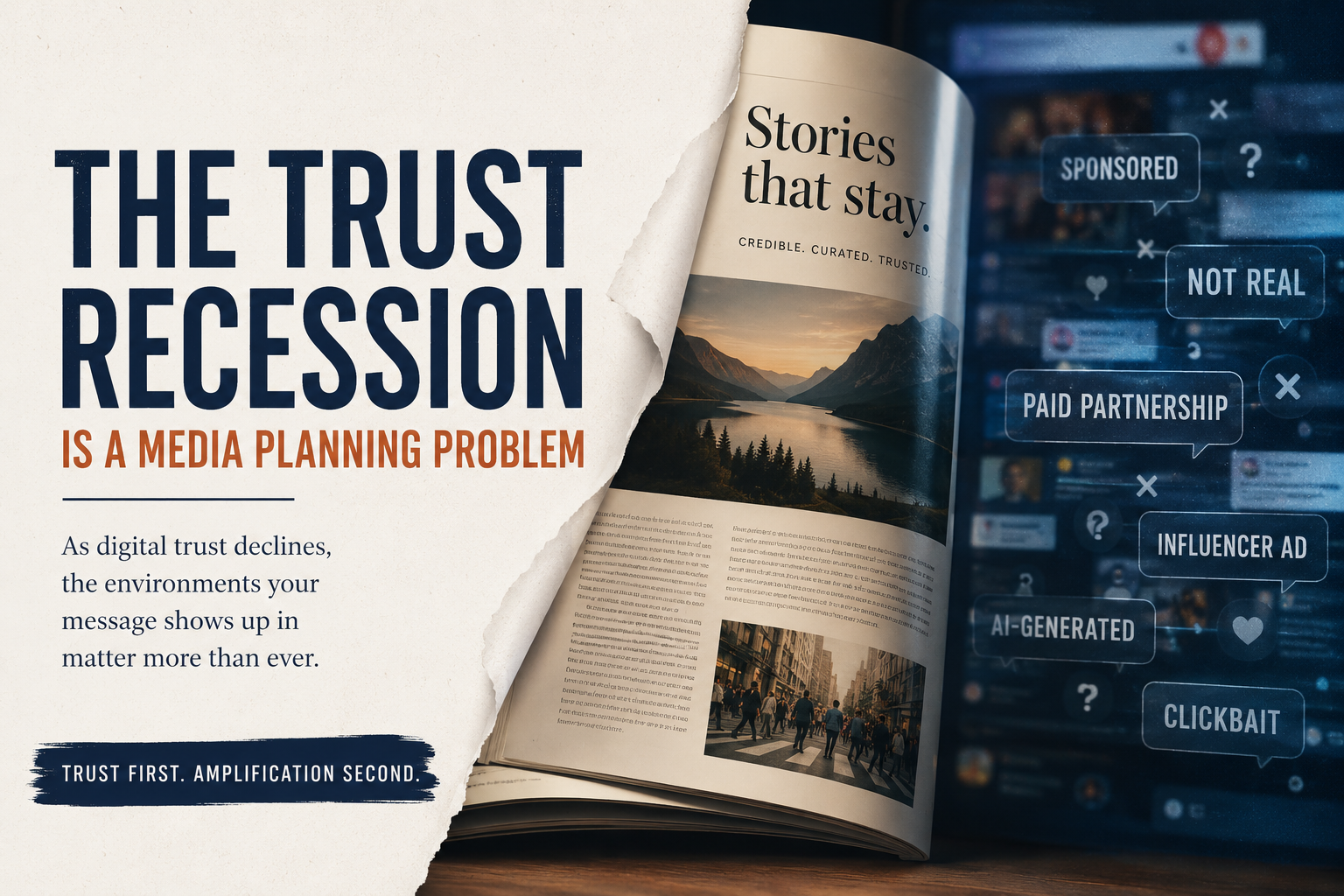

We have spent years making media faster, more measurable, more automated, and more efficient. But what happens when consumers stop trusting the environments we have worked so hard to optimize?
That is the question I have been thinking about since reading a recent piece from In Real Life Media about Gen Z and the collapse of digital trust.
The premise is pretty simple: The generation advertisers are working incredibly hard to reach is also becoming increasingly skeptical of what it sees online. Sponsored content, influencer recommendations, reviews, AI-generated imagery, branded posts pretending not to be branded posts. When everything can be created, manipulated, targeted, and optimized, consumers get pretty good at questioning everything.
And this feels bigger than Gen Z.
We are not simply dealing with fragmented attention anymore. Increasingly, we are dealing with fragmented trust. That should matter to every media buyer.
For years, the media conversation has been dominated by efficiency. Can we reach more people? Can we lower the CPM? Can we optimize faster? Can we better prove the click, visit, or conversion?
All important questions. But maybe there is another one we need to put back into the conversation: Does the environment itself make the message more believable?
That is where print gets interesting again.
There is something fundamentally different about a brand appearing inside an established publication, surrounded by editorial people who have intentionally chosen to consume. The environment carries weight. The publication has a relationship with its audience. The advertising enters that relationship rather than interrupting it.
This does not mean digital is going away, nor should it. It means print may have a different job to do within the plan. It can create credibility, context, presence, and then work alongside digital channels that amplify, retarget, and convert. Maybe the question is not print versus digital at all. Maybe it is, which medium is best suited to do which job.
Here is where I think the media industry owns part of the problem.
Print can offer trusted environments, strong editorial context, highly specific audiences, and real cultural relevance. Yet compared with digital media, discovering and buying print can still feel unnecessarily complicated.
Finding the right publication. Understanding upcoming editorial. Comparing opportunities. Knowing what inventory is available. Connecting with the right seller. Managing conversations across multiple publishers. We should not confuse friction in the buying process with weakness in the medium.
We believe buyers should be able to explore premium print opportunities across publishers much more easily, whether they are planning for a national advertiser, regional business, or local market. The technology around print should be as modern as the strategy behind it. Because if trust is becoming more valuable, making trusted environments easier to discover and buy becomes increasingly important.
We are living through something that feels very much like a trust recession.
And perhaps one of the most interesting opportunities in media right now is not finding another way to generate more impressions.
It is finding better places to put them.
If print has not been part of your consideration set lately, it might be worth another look.
